EL WAHDA

EL WAHDA

Monday, February 7, 2011

The danger to Egypt's revolution comes from Washington

Ali Abunimah, The Electronic Intifada, 6 February 2011


Protesters stand in front of grafitti calling on the US government to stay out of Egypt's affairs, 2 February. (Matthew Cassel)


Ali Abunimah is co-founder of The Electronic Intifada, author of One Country: A Bold Proposal to End the Israeli-Palestinian Impasse and is a contributor to The Goldstone Report: The Legacy of the Landmark Investigation of the Gaza Conflict (Nation Books).


The greatest danger to the Egyptian revolution and the prospects for a free and independent Egypt emanates not from the "baltagiyya" -- the mercenaries and thugs the regime sent to beat, stone, stab, shoot and kill protestors in Cairo, Alexandria and other cities last week -- but from Washington.

Ever since the Egyptian uprising began on 25 January, the United States government and the Washington establishment that rationalizes its policies have been scared to death of "losing Egypt." What they fear losing is a regime that has consistently ignored the rights and well-being of its people in order to plunder the country and enrich the few who control it, and that has done America's bidding, especially supporting Israel in its oppression and wars against the Palestinians and other Arabs.

The Obama Administration quickly dissociated itself from its envoy to Egypt, Frank Wisner, after the latter candidly told the BBC on 5 February that he thought President Hosni Mubarak "must stay in office in order to steer" any transition to a post-Mubarak order ("US special envoy: 'Mubarak must stay for now'," 5 February 2011).

But one suspects that Wisner was inadvertently speaking in his master's voice. US President Barack Obama and his national security establishment may be willing to give up Mubarak the person, but they are not willing to give up Mubarak's regime. It is notable that the US has never supported the Egyptian protestors' demand that Mubarak must go now. Nor has the United States suspended its $1.5 billion annual aid package to Egypt, much of which goes to the state security forces that are oppressing protestors and beating up and arresting journalists.

As The New York Times -- always a reliable barometer of official thinking -- reported, "The United States and leading European nations on Saturday threw their weight behind Egypt's vice president, Omar Suleiman, backing his attempt to defuse a popular uprising without immediately removing President Hosni Mubarak from power." Obama administration officials, the newspaper added, "said Mr. Suleiman had promised them an 'orderly transition' that would include constitutional reform and outreach to opposition groups" ("West Backs Gradual Egyptian Transition," 5 February 2011).

Moreoever, the Times reported, the United States has already managed to persuade two of its major European clients -- the United Kingdom and Germany -- to back continuing the existing regime with only a change of figurehead.

Suleiman, long the powerful chief of Egypt's intelligence services, has served -- perhaps even more so than Mubarak -- as the guarantor of Egypt's regional role in maintaining the American- and Israeli-dominated order. As author Jane Mayer has documented, Suleiman played a key role in the US "rendition" program, working closely with the CIA which kidnapped "terror suspects" from around the world and delivered them into Suleiman's hands for interrogation, and almost certainly torture ("Who is Omar Suleiman?," The New Yorker, 29 January 2011).

High praise for Suleiman's work has also come from top Israeli military brass. "I always believed in the abilities of the Egyptian Intelligence service [GIS]," Israeli General Amos Gilad told American, Palestinian Authority and Egyptian officials during a secret April 2007 meeting whose leaked minutes were recently released by Al Jazeera as part of the Palestine Papers. "It keeps order and security among 70 millions -- 20 millions in one city [a reference to the population of Egypt, actually closer to 83 million, and to Cairo] -- this is a great achievement, for which you deserve a medal. It is the best asset for the Middle East," Gilad said.

The notion that anyone, let alone US officials, could believe that Suleiman would lead an "orderly transition" to democracy would be laughable if it were not so sinister. Much more likely, the strategy is to try to ride out the protests and wear out and split the opposition, consolidate the regime under Suleiman's ruthless grip with the backing of the Egyptian army, and then enact cosmetic "reforms" to keep the Egyptian people politically divided and busy while business carries on as usual. Under any Suleiman "transition" political activists, journalists and anyone suspected of being part of the current uprising would be in grave danger.

From the American perspective, the strategy can be likened to what happened in the summer of 2008 when the house-of-cards international financial system started to collapse. Think of the Tunisian regime of deposed dictator Zine El Abidine Ben Ali as the investment bank Lehman Brothers. When a run on the bank began, the United States government refused to provide it with financial guarantees to bail it out, and it quickly went bankrupt.

But when the panic spread and even larger "too big to fail" financial firms including massive insurance company AIG began to see their positions suddenly deteriorate, the United States government stepped in to bail them out with hundreds of billions of dollars.

The Egyptian regime is the AIG of the region and what we are seeing now is an American attempt to bail it out. If Egypt goes under, the United States fears that the contagion would spread as Arab publics realize that the US-backed despots who rule them can be replaced, and that the toppling of these regimes whose only promise to their people has been "security" is not the end of the world but the start of renewal.

Of course, no analogy is exact. Whereas, allowing Lehman Brothers to collapse was a calculated decision, the United States did not see the revolution in Tunisia, or the uprising in Egypt coming. "Our assessment is that the Egyptian government is stable and is looking for ways to respond to the legitimate needs and interests of the Egyptian people," Secretary of State Hillary Clinton infamously declared on 25 January, the day the anti-regime protests broke out ("US urges restraint in Egypt, says government stable," Reuters, 25 January 2011).

Clinton's cluelessness is reminiscent of her predecessor Condoleezza Rice's famous words ("didn't see it coming") in relation to Hamas' victory in Palestinian legislative council elections in 2006.

According to The New York Times, Obama himself is unhappy with US intelligence failures in the Arab world ("Obama Faults Spy Agencies' Performance in Gauging Mideast Unrest, Officials Say," 4 February 2011). For close watchers of the United States, this obliviousness is no mystery.

As Helena Cobban has observed, the Israel Lobby, "AIPAC and its attack dogs," have conducted such a thorough "witch-hunt" over the past quarter century "against anyone with real Middle East expertise that the US government now contains no-one at the higher (or even mid-career) levels of policymaking who has any in-depth understanding of the region or of the aspirations of its people" ("Obama's know-nothings discuss Egypt," 28 January 2011).

But it is even worse than that. The US "policy" establishment seems only capable of viewing the region through Israeli eyes. This is why for so many officials and commentators the concerns of Israel to maintain a brutal hegemony trump the aspirations of 83 million Egyptians to determine their own future free from the shackles of the regime that has oppressed them for so long.

And different futures are possible. On the minds of many observers is the "Turkish model" of constitutional democracy, economic resurgence and foreign policy independence, all under the rule of a "moderate" Islamist party. Turkey, once closely in the orbit of the United States, started to break out with its refusal to allow the US to use the country's bases for the invasion of Iraq in 2003.

In recent years, Turkey has developed a deliberate "360 degree" foreign policy doctrine which includes maintaining relations with Europe and the United States, while restoring close ties with all its neighbors among them Iran and Arab countries, and assuming a greater regional mediating role. Since 2009, Turkey's once close alliance with Israel has deteriorated sharply, even though ties have not been cut. These shifts, along with its ubiquitous consumer and cultural products have given Turkey enormous regional influence and appeal.

Turkey has its own specific history and is no more perfect than any other country. But the bigger point is that subservience to the United States and Israel is not Egypt's only option. The worst case scenario from the American viewpoint is to have three major regional powers, Iran, Turkey and Egypt, that are not under Washington's control.

Of course Turkey is carving out its own path and Egyptians are struggling to go their own way which may be very different. There's no reason either to believe that Egypt would become "another Iran" as ceaseless Israeli propaganda suggests. But given a free choice, Egypt is not likely serve the "interests" of the United States and Israel the way the Mubarak regime has.

One example is that Egypt might dispense with US aid and still come out ahead by simply selling its natural gas on international markets rather than to Israel at what is reported to be a deep discount. Another is that a truly independent Egypt would eschew serving as Israel's proxy in enforcing the criminal siege of Gaza and stoking intra-Palestinian divisions.

By coming to the streets in their millions, by sacrifing the lives of some of their very finest, the Egyptian people have said that they and they alone want to decide their nation's future. Mubarak as a person is already irrelevant. The confrontation is now between the Egyptian people's desire for democracy and self-determination on the one hand, and, on the other, US insistence (along with its clients in Egypt and the region) on continuing the old regime. Let us offer whatever solidarity we can from wherever we are to help the Egyptian people to win.

Monday, December 27, 2010

Two years after Gaza massacre


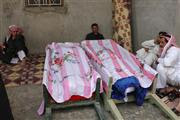
The ambulance which Arafa Abd al-Dayem was loading when he was fatally struck by an Israeli-fired dart bomb.


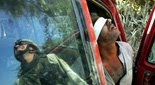
Ahmed Abu Foul in the destroyed Palestine Red Crescent Society station, Ezbet Abed Rabbo.

The Gaza massacre and the struggle for justice
Ali Abunimah, The Electronic Intifada, 27 December 2010

The Gaza massacre, which Israel launched two years ago today, did not end on 18 January 2009, but continues. It was not only a massacre of human bodies, but of the truth and of justice. Only our actions can help bring it to an end.

The UN-commissioned Goldstone Report documented evidence of war crimes and crimes against humanity committed in an attack aimed at the very "foundations of civilian life in Gaza" -- schools, industrial infrastructure, water, sanitation, flour mills, mosques, universities, police stations, government ministries, agriculture and thousands of homes. Yet like so many other inquiries documenting Israeli crimes, the Goldstone Report sits gathering dust as the United States, the European Union, Palestinian Authority and certain Arab governments colluded to ensure it would not translate into action.

Israel launched the attack, after breaking the ceasefire it had negotiated with Hamas the previous June, under the bogus pretext of stopping rocket firing from Gaza.

During those horrifying weeks from 27 December 2008 to 18 January 2009, Israel's merciless bombardment killed 1,417 people according to the Palestinian Centre for Human Rights in Gaza.

They were infants like Farah Ammar al-Helu, one-year-old, killed in al-Zaytoun. They were schoolgirls or schoolboys, like Islam Khalil Abu Amsha, 12, of Shajaiyeh and Mahmoud Khaled al-Mashharawi, 13, of al-Daraj. They were elders like Kamla Ali al-Attar, 82 of Beit Lahiya and Madallah Ahmed Abu Rukba, 81, of Jabaliya; They were fathers and husbands like Dr. Ehab Jasir al-Shaer. They were police officers like Younis Muhammad al-Ghandour, aged 24. They were ambulance drivers and civil defense workers. They were homemakers, school teachers, farmers, sanitation workers and builders. And yes, some of them were fighters, battling as any other people would to defend their communities with light and primitive weapons against Israel's onslaught using the most advanced weaponry the United States and European Union could provide.

The names of the dead fill 100 pages, but nothing can fill the void they left in their families and communities ("The Dead in the course of the Israeli recent military offensive on the Gaza strip between 27 December 2008 and 18 January 2009," PDF Palestinian Centre for Human Rights, 18 March 2009).

These were not the first to die in Israeli massacres and they have not been the last. Dozens of people have been killed since the end of Israel's "Operation Cast Lead," the latest Salameh Abu Hashish last week, a 20-year old shepherd shot by Israeli occupation forces as he tended his animals in northern Gaza.

But the tragedy does not end with those who were killed. Along with thousands permanently injured, there is the incalculable psychological cost of children growing up without parents, of parents burying their children, and the mental trauma that Israel's offensive and the ongoing siege has done to almost everyone in Gaza. There are the as yet unknown consequences of subjecting Gaza's 700,000 children to toxic water supply for years on end.

The siege robs 1.5 million people not just of basic goods, reconstruction supplies virtually nothing has been rebuilt in Gaza), and access to medical care but of their basic rights and freedoms to travel, to study, to be part of the world. It robs promising young people of their ambitions and futures. It deprives the planet of all that they would have been able to create and offer. By cutting Gaza off from the outside world, Israel hopes to make us forget that the those inside are human.

Two years after the crime, Gaza remains a giant prison for a population whose unforgivable sin in the eyes of Israel and its allies is to be refugees from lands that Israel took by ethnic cleansing.

Israel's violence against Gaza, like its violence against Palestinians everywhere, is the logical outcome of the racism that forms the inseparable core of Zionist ideology and practice: Palestinians are merely a nuisance, like brush or rocks to be cleared away in Zionism's relentless conquest of the land. This is what all Palestinians are struggling against, as an open letter today from dozens of civil society organizations in Gaza reminds us:

"We Palestinians of Gaza want to live at liberty to meet Palestinian friends or family from Tulkarem, Jerusalem or Nazareth; we want to have the right to travel and move freely. We want to live without fear of another bombing campaign that leaves hundreds of our children dead and many more injured or with cancers from the contamination of Israel's white phosphorous and chemical warfare. We want to live without the humiliations at Israeli checkpoints or the indignity of not providing for our families because of the unemployment brought about by the economic control and the illegal siege. We are calling for an end to the racism that underpins all this oppression."

Those of us who live outside Gaza can look to the people there for inspiration and strength; even after all this deliberate cruelty, they have not surrendered. But we cannot expect them to bear this burden alone or ignore the appalling cost Israel's unrelenting persecution has on the minds and bodies of people in Gaza or on society itself. We must also heed their calls to action.

$79,000 of our $100,000 goal raised. Can you help us make it the rest of the way so we can keep publishing through 2011?

One year ago, I joined more than a thousand people from dozens of countries on the Gaza Freedom March in an attempt to reach Gaza to commemorate the first anniversary of the massacre. We found our way blocked by the Egyptian government which remains complicit, with US backing, in the Israeli siege. And although we did not reach Gaza, other convoys before, and after, such as Viva Palestina did, only after severe obstruction and limitations by Egypt.

Yesterday, the Mavi Marmara returned to Istanbul where it was met dockside by thousands of people. In May the ship was part of the Gaza Freedom Flotilla which set out to break the siege by sea, only to be attacked and hijacked in international waters by Israeli commandos who killed nine people and injured dozens. Even that massacre has not deterred more people from seeking to break the siege; the Asian Convoy to Gaza is on its way, and several other efforts are being planned.

We may look at all these initiatives and say that despite their enormous cost -- including in human lives -- the siege remains unbroken, as world governments -- the so-called "international community" -- continue to ensure Israeli impunity. Two years later, Gaza remains in rubble, and Israel keeps the population always on the edge of a deliberately-induced humanitarian catastrophe while allowing just enough supplies to appease international opinion. It would be easy to be discouraged.

However, we must remember that the Palestinian people in Gaza are not objects of an isolated humanitarian cause, but partners in the struggle for justice and freedom throughout Palestine. Breaking the siege of Gaza would be a milestone on that march.

Haneen Zoabi, a Palestinian member of the Israeli parliament and a passenger on the Mavi Marmara explained last October in an http://electronicintifada.net/v2/article11599.shtml with The Electronic Intifada that Israeli society and government do not view their conflict with the Palestinians as one that must be resolved by providing justice and equality to victims, but merely as a "security" problem. Zoabi observed that the vast majority of Israelis believe Israel has largely "solved" the security problem: in the West Bank with the apartheid wall and "security coordination" between Israeli occupation forces and the collaborationist Palestinian Authority in Ramallah, and in Gaza with the siege.

Israeli society, Zoabi concluded, "doesn't feel the need for peace. They don't perceive occupation as a problem. They don't perceive the siege as a problem. They don't perceive oppressing the Palestinians as a problem, and they don't pay the price of occupation or the price of [the] siege [of Gaza]."

Thus the convoys and flotillas are an essential part of a larger effort to make Israel understand that it does have a problem and it can never be treated as a normal state until it ends its oppression and occupation of Palestinians in the West Bank and Gaza Strip, and fully respects the rights of Palestinian citizens of Israel and Palestinian refugees. And even if governments continue to stand by and do nothing, global civil society is showing the way with these efforts to break the siege, and with the broader Palestinian-led campaign of boycott, divestment and sanctions (BDS).

Amid all the suffering, Palestinians have not celebrated many victories in the two years since the Gaza massacre. But there are signs that things are moving in the right direction. Israel begs for US-endorsed "peace negotiations precisely because it knows that while the "peace process" provides cover for its ongoing crimes, it will never be required to give up anything or grant any rights to Palestinians in such a "process."

Yet Israel is mobilizing all its resources to fight the global movement for justice, especially BDS, that has gained so much momentum since the Gaza massacre. There can be no greater confirmation that this movement brings justice within our grasp. Our memorial to all the victims must not be just an annual commemoration, but the work we do every day to make the ranks of this movement grow.

Ali Abunimah is co-founder of The Electronic Intifada, author of One Country: A Bold Proposal to End the Israeli-Palestinian Impasse and is a contributor to The Goldstone Report: The Legacy of the Landmark Investigation of the Gaza Conflict (Nation Books).

Peace

Peace